The days of manual targeting, csv uploads, and pixel-based optimization are gone.
Top D2C brands have upgraded to a new signal-first, first-party data playbook and their ROAS shows it.
From Broad Lookalikes → To Precise New Customer Acquisition
| Old Playbook | New Playbook |
|---|---|
| Marketers used to build lookalike audiences from pixel data, hoping Meta would automatically find the right buyers. | Using synthetic / signal engineering “new_customer_purchase” events to train Meta on first-time buyer intent. |
| But overlapping with already engaged users and existing customers — plus poor signal quality — led to higher CPAs and diluted performance. | Meta learns to optimize for actual new customers, not just similar profiles. |
| Brand saw 45% lift in the new customers by training the Meta algorithm using the synthetic event “new customer purchase” at very controlled CPP. |
**From Generic “Purchase” → To “High-Value Customer” purchase event Optimization**
| Old Playbook | New Playbook |
|---|---|
| Marketers now and used to optimized for the default “Purchase” event and treating all sales equally. | With signal engineering, using a custom “high_AOV_purchase” event to help Meta prioritize profitable customers. |
| Meta learned from every low-ticket order and did not find more high values due to non-segmentation. | Meta learns better from linear high-value conversions and brings in people who are likely to buy high value products. |
| That led to more sales, but lower margin. | Here is a brand story of optimizing the campaign with high AOV purchases and saw 37% ROAS lift. |
**From ad account optimized for one hero product → To Category-Level Scaling******
| Old Playbook | New Playbook |
|---|---|
| The Ad account often gets skewed for one product which gets high sales. | Using signal engineering, built category-based custom events (shoes_purchase, bags_purchase, etc.) for diversified scaling. |
| Campaigns collapsed when one product fatigued. We even add multiple adsets / ads for other products .. the campaign doesn’t train to sell the non-hero products. | Category-level optimized campaigns allow scaling multiple verticals in parallel and each campaign becomes an AI algorithm itself. |
| Unstable performance across seasons. | Brand scaled all the category of the business and showed a 200% ROAS lift with consistent multi-category growth. |
****From Pixel Tracking → To Server-Side First-Party Signals********
| Old Playbook | New Playbook |
|---|---|
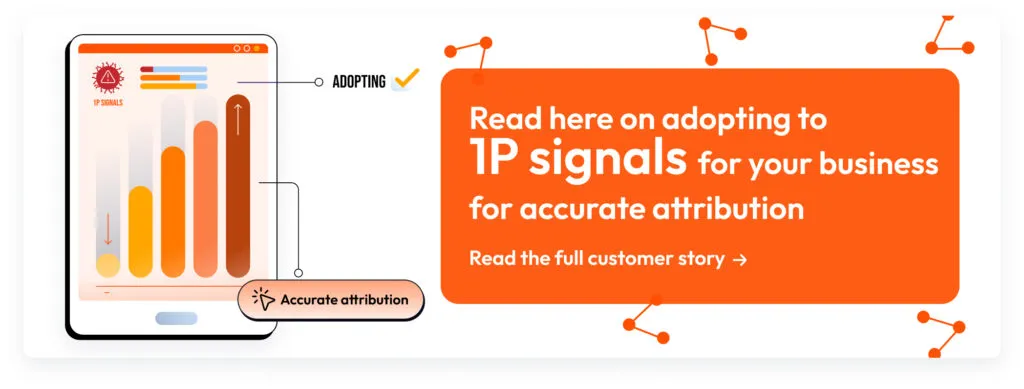
| Marketers used to send the broken signal data of their users without the extra parameters .. Hence which the attribution on Meta was always not right. | Now, marketers use server-side first-party (1P) tracking for accurate, privacy-compliant event data. |
| This happened because marketers relied on Meta pixel tracking however, Meta deletes them in 28days and attribution is lost completely. | First-party signals never expire — enabling long-term optimization and attribution beyond 28, 45, or even 90 days. |
| Depended on browser pixels — lost accuracy to ad blockers and cookies.Leaky, short-lived data. | Every purchase is tied back to the right campaign, ensuring crystal-clear attribution. Already, 1500+ brands have switched to 1P Signals to power their entire marketing ops — and their attribution is now rock solid. |
******From health and wellness blocked from running ads —> Freely running meta ads privacy complaint******
| Old Playbook | New Playbook |
|---|---|
| In the old way, brands and marketers used to run ads by sending all visitor data — including personal and sensitive health information — directly to Meta. | Now, marketers using first-party data can send all web and offline conversions — including CRM events — to Meta safely. |
| But this approach doesn’t work anymore. Meta blocked such accounts to comply with privacy laws, as sharing sensitive data violates HIPAA and GDPR | Personal and health data are hashed, keeping everything fully HIPAA and GDPR compliant. |
| The performance didn’t drop but stopped totally to bankruptcy | Your performance is back on track — accurate, compliant, and unstoppable. |
Want to see how these brands scaled profitably?